Surviving pieces of old Peking are sprinkled across the capital like little ancient islands amidst a rising tide of urban modernity. These precious parts of the past, the alleyway environment and its way of life still abound, but at increasingly scattered locations, forming a hutong archipelago in the forgotten city.
October is widely regarded as the best time of year here with a comfortable climate and the longest continuous streak of blue-sky days in a month. The first week during National Day holiday is especially fine as Beijing gets a breather with lighter traffic and most construction workers hanging up their hardhats and taking a break.
If you’re staying put for the National Day celebrations, it’s a good opportunity to go exploring around the “Golden Treasure” islands for a genuine narrow byway experience that’ll broaden your horizons. It takes most of a day to systematically meander by foot, or half a day to investigate by bike.
The island chain effect was formed over the last few years by the creation of Jinbao Jie, or Golden Treasure Street. A flood of concrete for construction projects created this new division between the Jianguomen and Chaoyangmen neighborhoods. Jinbao combines the gold from Goldfish Lane (Jinyu Hutong) on its western end and the treasure from Dayabao Hutong (Big Elegant Treasure Alley).
These sub-districts are worth visiting, both as evidence of historical erosion and to see the remains of a hardy human ecosystem dating back to the Yuan dynasty. The area is bounded by Jianguomennei Dajie on the south and Chaoyangmennei Dajie on the north. The western border is formed by the busy shopping streets of Dongdan Beidajie and Dongsi Nandajie, while the western side is defined as Chaoyangmen Nanxiaojie, an old thoroughfare freshly widened this century. There’s little to see east of Nanxiaojie to the Second Ring Road, bar a few one-stop islets like Zhihua Temple.
The wisest approach is to ride a bike through the southern islands of Golden Treasure Street, starting at Beijige Santiao, across the street from the northwest corner of the Oriental Plaza, then heading east. The first stop is a couple of meters into the alley, the remnants of a prince’s palace called the Ningjun Wangfu also known as Xieqin Wangfu. The palace belonged to the 13th son of the Qing Emperor Kangxi, who survived a bitter struggle for succession by not vying for the throne against his numerous male siblings. The winner, Yongzheng (r. 1723-1735), made his half brother a trusted advisor in charge of finance and water conservancy.
While it’s consistently difficult to get past the jealous palace gatekeepers for more than a harassed glimpse, the next stop, left then right around the corner, number 21, is easier to penetrate. Behind the colonnaded arched entryway is one of two secret gardens in the area, Western-style housing dormitories completed in 1921 for foreign doctors and nurses staffing the Peking Union Medical Hospital, or Xiehe. The other compound is on Waijiaobu Jie.
The old environment heading north from Beijige Santiao to Dongtangzi Hutong is eroding fast. Large chunks of the courtyard housing are already gone and the remainder is a reminder (like this picture of Xinkai Lu) of the future, not the past. On Xizongbu Hutong there is a sign noting the memorial temple of late Qing statesman Li Hongzhang (1823-1901) and a fragment of the vermilion wall that once encased it.
Aside from the doctors’ dorm on Waijiaobu Jie (Foreign Affairs Street), the other noteworthy edifice is the reception hall entrance of the foreign ministry built in 1909. It also served as the first Foreign Ministry of the PRC between 1949 and 1966. There is no marker for the original foreign ministry established during the Qing dynasty, located on Dongtangzi Hutong. On the west end of that alley was the residence of the noted educator Cai Yuanpei (1868-1948).
The hutong environment is much better on the island north of Jinbao Jie. It’s great for pictures and mixing with residents. Start east to west on Ganmian Hutong, crisscross northward to Shijia Hutong (once the home of Mao’s successor Hua Guofeng and now the Haoyuan Guesthouse), followed by Neiwubu Jie (Interior Ministry Street). Be sure to check out the courtyard just inside the northeast corner.
You can only go west to east on Bence and Dengce Hutongs as they merge with other paths: Bence takes you to Yanyue Hutong (Practice Music Alley); Dengce drops you on to Lishi Hutong (Ceremonious Official Lane). Both are great. Unfortunately the stunning residence on Lishi, which once served as the Indonesian Embassy, is not open to the public. The north island of the Golden Treasure chain ends with Qianchaomian Hutong, and then you’re back in today’s Beijing. Ed Lanfranco
Beijing Trip Guide

Showing posts with label famous attractions in beijing. Show all posts
Showing posts with label famous attractions in beijing. Show all posts
Friday, October 20, 2006


Saturday, September 23, 2006
Beihai Park

Situated in the center of Beijing, Beihai (North Sea) is one of the most popular parks in the city of Beijing. It covers a total area of over 68 hectares, more than half of it is taken up by the lake.
Early in the 10th century, the Liao Dynasty built a secondary imperial residence here, called Yaoyu or Jade Islet. When the Jin took over, they renamed the capital Zhongdu, meaning Central Capital, and built an imperial palace. Qionghua (Jade Flowery) Islet was built of earth dug out from the lake, and the rocks used for piling on the hill were brought from Kaifeng, Henan Province. During the Yuan Dynasty, the place was rebuilt three times, and Guanghandian or the Palace in the Moon where Kublai Khan used to live and many other palace buildings were built on top of the hill. It was in this palace that Kublai Khan received Marco Polo. Unfortunately it was destroyed. The Islet became the centre of Dadu (Great Capital) and is still situated in the heart of modern Beijing.
The Ming Dynasty saw more construction and renovation: the Five Dragon Pavilions and the Nine-Dragon Screen on the north bank of the lake and many pavilions and galleries were erected during that period. From the White Dagoba, visitors can have an excellent view of the Five Dragon Pavilions standing on the opposite bank of the lake, with colourful ferry boats travelling back and forth between the shores. During the reign of Emperor Qianlong, construction lasted for 30 years. The project included many other pavilions, halls and terraces which made the park even more harmonious in design.
The layout of the park is based on an ancient Chinese legend. According to the legend, there were supposed to be three islands to the east of Bohai Bay where the gods lived. One of them was called Penglai Island where a kind of herbal medicine grew, that was supposed to prolong life. The first emperor of the Qin Dynasty wanted to live fovrever. He sent people to the islands to look for the longevity medicine, but failed. Emperor Wudi of the Han Dynasty also wanted to live an eternal life. He ordered that a big pool be dug at the back of his palace, complete with three artificial hills to represent Penglai and the other islands. So these legendary hills were built in the eastern capital of Luoyang during the Sui Dynasty and also in the Tang Dynasty capital of Chang'an. Such a traditional style of gardening was followed during the succeeding dynasties and Beihai Park was built after this traditional style.
Yonghegong Lamasery
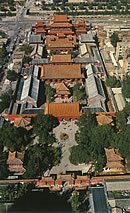
Yonghegong is a famous lamasery located in the northeastern part of the old city of Beijing. It was a palatial residence built in 1694 by Qing Emperor Kangxi for his fourth son, Prince Yongzheng who later succeeded to the throne. This magnificent temple consists of five main buildings lying on the north-south axis, with annex halls standing on both sides. The temple is listed by the Chinese Government as one of the important historical monuments under special preservation.
After the death of his father, Emperor Yongzheng moved to the Forbidden City. The compound was closed to ordinary people and was renamed Yonghegong (the Palace of Harmony). Green roof tiles were replaced by yellow ones to suit a monarch's home. In 1744 his successor Emperor Qianlong converted the palace into a lamasery.
Several renovations have been carried out since 1949. The temple has taken on a new look and was reopened to the public in 1981. It is now not only a functional lama temple, but also a tourist attraction.
Ming Tombs

The Ming Tombs, consisting of 13 emperor tombs of the Ming Dynasty, is situated in the southern foothills of Yianshou Mountain northwest of Beijing. Two of the 13, Changling and Dingling, are excavated and open to the public.
Approach to the Ming Tombs is a seven kilometers stone-paved road, beginning with a very impressive archway of carved white marble erected in 1540, followed by giant-size single-stone statues of 24 animals and 12 humans.
In front of Changling, the largest of the 13 Tombs, is the marble-based 1,956 square meters Ling En Hall built 570 years ago. It is built of very precious wood and is China's largest wooden structure. 4 of the 32 huge pillars stand in the center, measuring 1.17 meters in diameter each. A two-story castle sits in the rear of the main hall.
Dingling is the tomb of Zhu Yijun, the 13th Ming emperor. It consists of similar surface structure and a Underground Palace. The Underground Palace is composed of the front, central, rear, and side halls. The whole palace is built compeletely with stone, and not a single piece of wood is used. There are no beams and the ceiling is arched. The rear hall is the Burial Chamber, where the emperor's coffin and the first and second empress's coffins were placed. Inside the coffins a large number of valuable relics were found. The unearthed relics, including porcelains, jade carvings, silk, woman's head-dresses decorated with golden phoenixes and jewels, wooden seals, and other precious article, are now on display in the Dingling museum.
The Ming tombs were put under protection of the Beijing municipal government in 1957.
In July 2003, the UNESCO World Heritage Committee at its 27th session officially inscribed Ming Tombs (Shisanling) in Beijing on the World Heritage List as assemblage of the Imperial Tombs of the Ming and Qing Dynasties.
Temple of Heaven
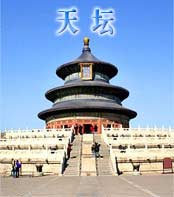
Tiantan Park is an icon of such enduring value that it shorthands the entire city. The park's classic Ming architecture gives it heaps of symbolic value and the name has been used to brand products from tiger balm to plumbing fixtures, as well as decorating a plethora of tourist literature. It's set in a 267-hectare (660-acre) park, with four gates at the cardinal points, and walls to the north and east. It originally functioned as a vast stage for solemn rites and rituals.
So beautifuly proportioned and positioned that it has become Beijing's "official civic symbol", Temple of Heaven was built between 1406 and 1420, the same time that Ming Emperor Yongle laid out and built the Forbidden City. He oversaw the construction of an enormous park and altar to heaven directly south of the palace. Each year on the winter solstice the emperor would lead a procession out of the Forbidden City across what is today Tiananmen Square southward down the Imperial Way to Tiantan, the Temple of Heaven, where he would perform rites and make sacrifices to the cosmos on behalf of China. Much of the architecture of these ancient rites survives in Tiantan Park (Tiantan Gongyuan), but what makes this park so singular among attractions in China is a single remarkable building, a magnificent tower known as the Hall of Prayer for Good Harvests (Qinian Dian).
The centerpiece Hall of Prayer for Good Harvests that dominates the complex is the city symbol and is a faithful reconstruction of the original, which burned in 1889. Inside, 28 wooden pillars support the 39-meter tower, whose three conical roofs are covered in blue glazed tiles reflecting the sky. The wooden walls are richly decorated inside and outside.
Elsewhere on the 273-hectare (674 acre) site are such wonderfully-named features as the Bridge of Vermilion Stairs, the Imperial Vault of Heaven and the Echo or Whispering Wall, whose remarkable acoustical design carries even whispered sounds over a distance. Nearby are the three terraces of the Circular Mound, where emperors offered up their prayers.
Come in the morning to enjoy the sunrise, breathe in the fragrance of the ancient cypress trees and perhaps join in the tai chi exercises and other activities of the assembled people.
Tickets attractions : 30.00 yuan season (November 1 to next year March 31), season 35.00 yuan (annually from April 1 to October 31)
Opening hours : 6:00——21:00 ( for major building inside 17:30 summer 16:30 winter)
Telephone : 67028866 (switchboard)
Summer Palace

It was designed eight centuries ago as a hot-season getaway for the royal and twice suffered extensively at the hands of Western troops but it retains its considerable beauty today.
Situated 20km northwest of Beijing, in the cool hills that rise from the plain on which the city humidly sits in the summer, Yiheyuan also witnessed extravagant celebrations that kept the pampered elite from boredom. It was further beautified by the Dwoager Empress Cixi, who almost broke the national treasury creating her personal Xanadu.
Today, with the repair of the damage inflicted in 1860 by the Anglo-Frech troops during the Second Opium War and in 1900 by rioters in the aftermath of the Boxer Rebellion, it retains the residence of the Empress Dwoager, Complete with its Furnishings and her personal effects.
The place is packed to the gunwales in summer with Beijing residents taking full advantage of Kunming Lake which takes up three-quarters of the park. The main building is the lyrically named Hall of Benevolence & Longevity, while along the north shore is the Long Corridor, so named because it's, well, long. There's over 700m (2300ft) of corridor, filled with mythical paintings and scenes. If some of the paintings have a newish patina, that's because many of the murals were painted over during the Cultural Revolution.
Long Corridor (Chang Lang)--This covered wooden promenade runs about half a mile (2,550 feet) along the northern shore of Kunming Lake, from the Eastern Halls to the Marble Boat. Its crossbeams, ceiling roof panels, and pillars are painted with more than 10,000 scenes from Chinese geography, history, literature, and myth, making this a promenade into a picture encyclopedia of China. The paintings are crude but bright, and the Long Corridor is exceptionally charming. Built in 1750 (and rebuilt and restored many times since), the Long Corridor consists of 273 crossbeam sections and four pavilions that lead to cafes, boat docks, or sites on Longevity Hill.
Hall of Benevolent Longevity (Renshou Dian)--Located directly across the courtyard from the East Gate entrance, this hall is where the Empress Dowager Cixi and her nephew (who was appointed emperor, but placed under her protection) received members of the court. Cixi occupied the dragon throne.
Hall of Jade Ripples (Yulan Tang)--This is the lakeside residence of the Empress Dowager's nephew, Emperor Guangxu, where he was kept from the throne, a prisoner of his aunt.
Hall of Happiness and Longevity (Leshou Tang)--This complex on the northeast tip of the lake was the Empress Dowager's private residence. Most of the furniture, the bed curtains, and the glass lamps (China's first electric lamps) are original. The Long Corridor begins here.
Great Wall
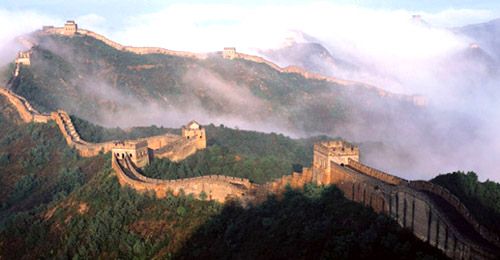
Despite the common assumption, the Great Wall can not be seen from the moon; it can, however, be viewed from astronauts in passing orbiters. It was also not built all at one, ti was built from the 5th to 16th centuries to be completed as a barrier against nomadic invaders from the north. The wall's origins date back at least to the 5th century b.c., when the rival kingdoms of the Warring States Period (453-221 b.c.) built defensive ramparts against their enemies. The First Emperor of unified China, Qin Shi Huang Di, fortified the barriers in the 3rd century b.c. Over a 10-year period, 300,000 conscripted laborers, many of them slaves, knit the walls into a continuous rampart to protect the western frontier. New sections extended the wall east to the Yellow Sea.
The Great Wall was constantly repositioned along new routes as successive dynasties rose and fell. In the year a.d. 607, more than a million workers toiled on this line of defense, but soon after the Great Wall was abandoned. The Mongols eventually broke through from the north and established the Yuan Dynasty (a.d. 1271-1368), making Beijing their capital. Their successors, the emperors of the Ming Dynasty (a.d. 1368-1644), set in motion the last great phase of wall building, which created the Great Wall as we see it today north of Beijing.
Its eastern foot rests in the Gulf of Bohai on the edge of the Yellow (or Eastern) Sea, its western 5,000km (3,333 miles) on the verges of the desert region.
Visitors to Beijing can visit the Wall at three locations: Bakaling, 80km north; and Simatai, 110km northeast. Built during the Ming Dynasty, the Badaling section is 7.8 meters high and 5.8 meters wide. While the ridge can be accessed on foot, the steep ascent is not for everyone and a cable car ride can be substituted.
Another restored sector, at Mutianyu, can also be explored by foot up its long, steep stairs and restful terraces or by a recently installed cable car. Both sides are often crowded, which has been left in its ruined state. However, while visitors to the two restored areas can go by tour bus, those traveling to Simatai must have their own guide and means of transprotation.
Forbidden City
With adjacent Tian'anmen Square, this has been Beijing's centerpiece attraction since more than 200,000 laborers built it for the third Ming Dynasty emperor Yongle in the early 1400s. 24 emperors and empresses of the Ming ans Qing (Manzu) dynasties made this their home and held court here across a span of 5 centures.
The 74-hectare (183 acre) complex is best known as the Forbidden City, denoting the fact that only the royal family, ministers and tribute-bearing ambassador were allowed inside. This ancient royal city, stuck in the heart of the modern city of Beijing like a life-sized time capsule, is nearly a half-mile wide (east to west) and more than a half-mile long (north to south). Its palaces, pavilions, and halls are divided into 9,000 rooms, and the whole complex is enclosed in thick walls over 30 feet tall and by a moat 170 feet across. Now the old world of beautiful concubines and priapic emperors, ball-breaking (and -broken) eunuchs and conspicuous wealth still hovers around the lush gardens, courtyards, pavilions and great halls of the palace.
The first of its three areas has four monumental gates and a moat spanned by five marble bridges. The magnificent Gate of Supreme Harmony, with its bronze guard-lions, leads to flagstone-paved courtyard accommodating 9,000 people on imperial ceremony occasions. The Hall of Supreme Harmony and the bronze incense burners and jade chimes for those events like beyond.
Next are the royal living quarters, whose small, intimate courtyards and palaces are now museums housing the dynastic clock, artwork, calligraphy and other collections. At the back are the ancient cypress and pine trees, and the well in which the Empress Dowager Cixi Drowned a concubine who was threatening her hold on power.
The 74-hectare (183 acre) complex is best known as the Forbidden City, denoting the fact that only the royal family, ministers and tribute-bearing ambassador were allowed inside. This ancient royal city, stuck in the heart of the modern city of Beijing like a life-sized time capsule, is nearly a half-mile wide (east to west) and more than a half-mile long (north to south). Its palaces, pavilions, and halls are divided into 9,000 rooms, and the whole complex is enclosed in thick walls over 30 feet tall and by a moat 170 feet across. Now the old world of beautiful concubines and priapic emperors, ball-breaking (and -broken) eunuchs and conspicuous wealth still hovers around the lush gardens, courtyards, pavilions and great halls of the palace.
The first of its three areas has four monumental gates and a moat spanned by five marble bridges. The magnificent Gate of Supreme Harmony, with its bronze guard-lions, leads to flagstone-paved courtyard accommodating 9,000 people on imperial ceremony occasions. The Hall of Supreme Harmony and the bronze incense burners and jade chimes for those events like beyond.
Next are the royal living quarters, whose small, intimate courtyards and palaces are now museums housing the dynastic clock, artwork, calligraphy and other collections. At the back are the ancient cypress and pine trees, and the well in which the Empress Dowager Cixi Drowned a concubine who was threatening her hold on power.
Tiananmen Square
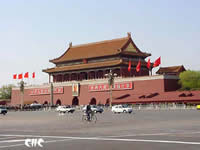
Located in the right center of Beijing, the capital of P.R.China, Tiananmen Square occupies an area of 49 hectares (122 acres), big enough to hold half a million people. As one of the largest city squares in the world, many annual and special celebrations and assemblies are held here. Parades take place here on important days, such as the rallies on May 1, International Labor Day and Oct 1, National Day.
In 1919, the May 4th Movement broke out in Beijing. Students and residents staged a patriotic demonstration in the square. In 1935, students in Beijing launched the December 9th Movement and held a demonstration in the square to against the Japanese aggression and Chiang Kai-shek(Jiang Jie Shi)'s policy of non-resistance. On April 5, 1976, lots of people gathered here to commemorate Zhou Enlai and oppose the 'Gang of Four'.
The Tiananmen Gate Tower sites at the north, the Five-Star Red Flag flies high on the square, the Monument to the People's Heroes dominates the center, the Great Hall of the People and the Museum of the Chinese Revolution and the Museum of Chinese History to the east and west of it, as well as The Chairman Mao Memorial Hall and the Zhengyangmen Gate (Qianmen), sit in the south of the square. Tens of thousands of people visit daily. It is the must place to visit in Beijing City.
Admission Fee: Free of charge for square visiting
Opening Hours: Whole day
Recommended Time for a Visit: one hour
Subscribe to:
Posts (Atom)