Beijing Trip Guide

Showing posts with label China Culture. Show all posts
Showing posts with label China Culture. Show all posts
Sunday, December 03, 2006
Chinese kungfu
Shaolin Quan or Shaolin Chuan originated in the Shaolin Temple on Mount Songshan at Dengfeng in Henan Province. It was named after the temple. The founder of the Shaolin Quan was said to be an Indian monk, Bodhi-dharma. The proposition, though very influential, was proved to be false, for there was a monk named BodhHiharma but he knew nothing at all about Chinese Chuan. In fact, Shaolin Quan was the manifestation of the wisdom of the monks of the temple, secular Wushu masters and army generals and soldiers.
According to historical records, the Shaolin Temple was built during the Northern Wei Dynasty in the 19th calendar year of the reign of Emperor Taihe (495) and is one of China's most famous an-cient temples. The Shaolin Temple once had many monks on its premises. Those monks of the lower level mostly came from the secular society and some of them knew some martial arts before entering the temple. Those who knew martial arts taught and helped each other to improve their skills. They also absorbed the experience of their predecessors and gradually developed their mar-tial arts into the unique Shaolin school.
During the Northern Qi Dynasty (550-577), Shaolin monks could lift hundreds of kilograms in weight and were good at Chuan and horse riding. By the end of the Sui Dynasty (581-618), Li Shimin, king of the Qin state, fought with the self-appointed emperor of the Zheng state, Wang Shichong. Shaolin monks Zhi Cao, Hui Yang, and Tan Zong took the side of Li and helped him catch the latter's nephew Wang Renze to force the self-appointed emperor to surrender. After Li Shimin was enthroned as the first emperor of the Tang Dynasty, he awarded his followers ac-cording to their military merits and contributions. Monk Tan Zong had the title of chief general con-ferred on him, while the Shaolin Temple was given large grants of land and money to expand the temple complex. The Shaolin Temple was allowed to organize an army of monk soldiers, who acted as military people in warring times and as monks in peace time. The Shaolin school of Chuan im-proved and developed through the trials of battles and wars.
The Shaolin monks in the Ming Dynasty (1368-1644) were all taught to practise Wushu. In the 32nd calendar year of the Jiajing reign (1553), the Shaolin military monks took part in the battles against Japanese invaders in southern China and accomplished many military exploits. Wang Shixing of the Ming Dynasty wrote in his Tour of Mount Song. "All of the 400 Shaolin Temple monks have good Wushu skills." "Fists and cudgels were wielded as if they were flying during practice." Cheng Chongdou also of the Ming Dynasty wrote in his book The Dossier of Shaolin Cudgel Fight: "Shaolin monks are best known for their cudgel fights." Ming general Yu Dayou, who was reputed for his anti-Japanese military service, went to teach cudgel fighting skills in the Shaolin Temple. It was in the latter half of the Ming Dynasty that Shaolin monks switched from cudgel fighting to fist fighting, so that fist fights could be promoted to match cudgel fights.
In the Qing Dynasty (1644-1911), the people living around the Shaolin Temple were very active in practising Wushu, which boosted the development of the Shaolin school of martial arts. In the Shao-lin Temple, the rear hall was used for Wushu exercises, where various kinds of weapons were dis-played on the weapon stands ready for use at any time. Some monks practised fist fighting to safe-guard the temple. After years of exercises and practising, foot prints were stamped on the brick floor of the rear hall and these prints can be seen clearly even today. On the north and south walls of the White-Clothes Hall, there are Qing Dynasty murals vividly depicting the exercises practised by monks in the temple.
In the fifth calendar year of the Yongzheng reign of the Qing Dynasty (1727), people were not allowed to practise Wushu. However, they could not be stopped either in the secular society or in the Shaolin Temple, where Wushu was practised underground.
Apart from the Shaolin Temple on Mount Songshan, the Shaolin Temple was said to have set up more than a dozen Shaolin affiliates in other temples in the country. The Shaolin Temple on Mount Nine Lotus in Fujian Province during the Ming Dynasty was famous for developing the Shaolin Quan.
Around the 1911 Revolution against the Qing Dynasty, the Shaolin martial arts underwent further developments. Wushu clubs were established all over the country and most of them took the Shaolin Quan. Lots of patriots organized sabre and flying sword groups in order to overthrow the dynasty. They constantly practised their skills and contributed greatly to the cause.
The Shaolin school is very popular in secular society with a myriad of followers. Over the years it was enriched theoretically and its techniques perfected to form a colossal system of fist fight.
Compactness is a feature of the Shaolin school. The moves and tricks of this school are short, simple and succinct as well as versatile. While fighting, Shaolin boxers would advance and retreat straight forwardly. They need only a small space to execute their style of fist fight which is des-cribed as "fighting along a single straight line." Shaolin Quart is powerful and speedy with rhythmic rising and falling of body movements. It stresses hardness of actions and blows but it also advocates softness in support of the hardness. The motto of the Shaolin fist fight says "hardness first and softness second." When jabbing or palming, the arm is required to be neither bent nor straight, in an attempt to blend external and internal forces.


Monday, November 20, 2006
silk road
Silk Road
China's vast western region is accessible to travelers along the classic Silk Road, the most important connection between the East and West. Goods traded along the route were mainly silk products and the name Silk Road.
At that time, only China grew mulberry, raised silkworms to make silk products. In 133BC, Emperor Wudi of the Han Dynasty (206BC-220AD) ordered to invade the Huns and established a relation with the west. In 77BC, Han invaded the Loulan state and in 60BC, the superintended government was set up to promote economic and cultural exchanges between them.
This ancient trade route starts in the old capitals of Luoyang and Xi'an (then called Chang'an), reaches the Yellow River at Lanzhou, then skirts westward along deserts and mountains before dividing into three routes at the oasis of Dunhuang.
When the ancient Silk Road came out of the Hexi Corridor into Xinjiang, it broke into three main sections. The eastern section ran from Chang'an to Yumen Pass or Yangguan Pass. The central section started from Yumen Pass or Yangguan Pass to Chongling (the Pamirs). The western section was divided to two routes: one ran through Iran, Iraq and The Mediterranean Sea to reach Europe, and the other ran northwestwards to reach Europe via the Aral Sea, the Caspian Sea and the Black Sea.
Generally speaking, the Silk Road brought the constant exchanges between the East and the West. Chinese textile products, papermaking technique and some art crafts were introduced to the west through the route. And the western music, dancing, painting astronomy, calendar and Buddhism were introduced into China.
There was also a Marine Silk Road which connected the southern China and the West.
people-chen 11/21/06, 1:32am
Friday, October 13, 2006
Chinese painting
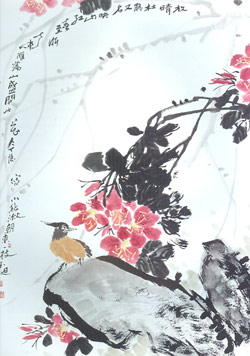
Chinese painting is famous in the world, it has a very long history
Chinese painting is an art. The painting is done using a brush on paper or silk, often with black ink alone. It is a monochromatic work of art derived, perhaps, from calligraphy. A Chinese painting is a distinctive object based on centuries-old traditions common to many things in China.
The roots of Chinese painting can be traced back to Chinese Neolithic pottery. Chinese painting was closely related to crafts like pottery as observed in the decorations used on decorative bronzes, carved jade and lacquer ware such as figures of fish, frogs, deer, birds, flowers, tree leaves and dancing people which dates back to around 6,000 to 7,000 years old. Paintings were mainly painted on silk or walls before the Tang Dynasty, and mural paintings were particularly popular. The earliest Chinese characters were pictographs.
Subscribe to:
Posts (Atom)