Saturday, September 30, 2006

Feet Massage


put one hand on top of the foot and the other under the sole, then stroke smoothly from your toes to your ankles. Glide your hands back to your toes and repeat.
Support your foot with one hand and work on each toe individually. Squeeze it firmly, and gently stretch each toe with a gentle pull.
With one thumb on top of the other, do a line of firm pressures down the center of the sole and lines on either side. Then, with one thumb, do circular pressures on the arch and the ball of the foot.
Support your foot with one hand and make the other into a loose fist.


Do knuckling movements all over the sole by rippling your fingers around in small circular movements.
Then, still holding the foot with one hand, hack the sole with your other hand, Flick your hand away the moment you touch the foot, so that the effect is light and springy.
Stroke around the ankle with your fingertips, as you stroke up toward the leg and gently as you glide back. Finish by stroking the foot as you did at the beginning.

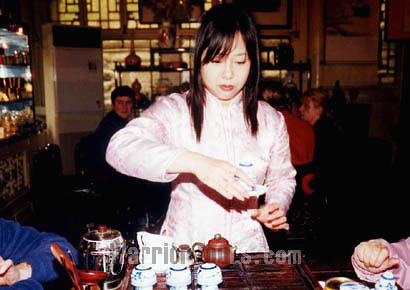
Tea Ceremony


The art of drinking and serving tea plays a major cultural role in China. It inspires poetry and songs. Mutual love of tea cements lifelong friendships. For centuries, the ritual of preparing and serving tea has held a special place in the hearts and minds of Chinese aristocracy, court officials, intellectuals and poets.
The Chinese tea ceremony emphasizes the tea, rather than the ceremony -- what the tea tastes like, smells like, and how one tea tastes compared to the previous tea, or in successive rounds of drinking. Ceremony doesn't mean that each server will perform the ritual the same way; it is not related to religion. Each step is meant to be a sensory exploration and appreciation.

Most teas used in the Chinese tea ceremony are grown in the mountains of Taiwan at around 4,000 feet. These teas are particularly refined, such as oolong teas which are lightly fermented and red teas that can be moderately to heavily fermented.
Tea house in Beijing
Dr tea that a biggest one in beijng ,there are pretty girls who can perform tea ceremony and teach tea making ,Beijing Dr tea which decorated in Chinese tradional culture style ,it,s also a good please for take rest during you stay in Beijing.

Fangshan


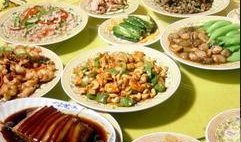
Beijing imperial food from the Ming and pre- Ming dynasties has mostly disappeared by today. What has been preserved is the Qing Dynasty imperial cuisine because its cooks passed down their knowledge and skills, and because the palace kept dietetic records.
General Feng Yuxiang (1882 - 1948) drove Puyi (1906 - 1967), the last Qing emperor, out of the Forbidden City in 1924 and disbanded the imperial garden, was opened to the public in 1925. Former cooks of the Qing imperial kitchen, Sun Shaoran, Wang Yushan, Wen Baotian, Niu Wenzhi, and Zhao Yongshou, then opened a tea – house in Beihai Park with help from Zhao Renzhai, former chief of the palace vegetable storehouse.

Their teahouse was named Fangshan, which means imitation imperial food. They specialized in making and selling the orthodox pastries of the Qing Palace. From making and selling tea, pastries, and refreshments, Fangshan gradually evolved into serving the traditional dishes of the Qing Palace. Many literati and tourists dined at the restaurant out of admiration for their imperial dishes. The restaurant soon became famous throughout the city because of its fresh raw materials, excellent cooking, and unique flavors.

Beijing imperial food from the Ming and pre- Ming dynasties has mostly disappeared by today. What has been preserved is the Qing Dynasty imperial cuisine because its cooks passed down their knowledge and skills, and because the palace kept dietetic records.
General Feng Yuxiang (1882 - 1948) drove Puyi (1906 - 1967), the last Qing emperor, out of the Forbidden City in 1924 and disbanded the imperial garden, was opened to the public in 1925. Former cooks of the Qing imperial kitchen, Sun Shaoran, Wang Yushan, Wen Baotian, Niu Wenzhi, and Zhao Yongshou, then opened a tea – house in Beihai Park with help from Zhao Renzhai, former chief of the palace vegetable storehouse. Their teahouse was named Fangshan, which means imitation imperial food. They specialized in making and selling the orthodox pastries of the Qing Palace. From making and selling tea, pastries, and refreshments, Fangshan gradually evolved into serving the traditional dishes of the Qing Palace. Many literati and tourists dined at the restaurant out of admiration for their imperial dishes. The restaurant soon became famous throughout the city because of its fresh raw materials, excellent cooking, and unique flavors.
The restaurant’s staple food was cooked wheaten products, such as baked sesame seed cakes with fried minced-meat filling and pastries shaped like apple, peach, fingered citron, and lucky rolls. Whatever wheaten food you ate, you received a good luck message: apple – all is well; peach – longevity, you will live a long life; lucky rolls – everything is fine.
Although imperial food originated with the common people, imperial food uses different raw materials. The rice, flour, meat, vegetables, melon, fruit, poultry, fish, and delicacies from land and sea were carefully chosen tributes from local officials throughout the country. They were unmatched in quality and purity.
Beijing fangshan of Cold dishes could not be combined on one plate. A plate of boiled chicken should just be boiled chicken and nothing else. A plate of jellyfish salad should be nothing but jellyfish salad, and the same for smoked fish, preserved eggs, and pork cooked in soy sauce. They should all be served on separate plates. There was nothing similar to the assorted cold dishes of today, which are modeled like a work of modern art.

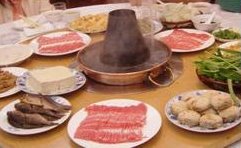
Hot pot


The hotpot is quite popular in Beijing ,especially in cold winter ,the Mongolian hotpot is mainly made with mutton and beef,but now apart from lamb and veal ,chicken,fish or prawn ,in fact ,everything can be used in the pot,and there are also some vegetables,bean-noodles,mushrooms,Chinese cabbages and bean-curd together with the hotpot, ou put them in to the boiling water in the hotpot by youself ,so people also call it do it youself style ,the sauce is prepared personally by the diner ,you may want hot,sweet or salty selection,the traditional food toaccompany the hotpot is sesame pancake or noodles,now Sichuan style spicy hotpot is also very popular in Beijing .

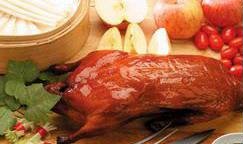
Beijing Roast Duck


Beijing Roast duck is thought to be one of the most delicious dishes all over the world; most visitors coming to Beijing will never forget to have a try.
The two famous restaurants that serve Beijing Roast Duck are Bianyifang Roast Duck Restaurant and Quanjude Roast Duck Restaurant
When roasted and dried, the duck will look brilliantly dark red, shining with oil and with crisp skin and tender meat. Because of its appearance, it really hard to resist to try it. The proper way to eat it is like this, frist take a layer of thin pancake in one hand ,then put 3 or 4 pieces ofduck slices on

to pancake ,dip some green onion or cucumber int to sweet soybean paste and then put them on the pancake together with duck slices and at last use your fingers to wrap the pancake in to a roll,and then serve. Sometimes people would like to put in mashed garlic and cucumber or carrot strips as well. Some young women like to dip slices into white sugar directly. Other parts of the duck will be served as either cold dishes with its livers, wings, stomach, webs and eggs, or hot dishes with its heart, tongue and kidneys. The bones can even be decocted together with Chinese watermelon and cabbage.

Tuesday, September 26, 2006

Beijing Night tour


Hutong Evening:Hutong, Dinner, Bar Street(Private vehicle and guide).US$58/p.p(Based on 2 Persons)
Famous Peking Duck Banquet & Chinese Kungfu Show (Private vehicle and guide).US$82/p.p(Based on 2 Persons)

Performace show


1. Peking Opera
Show starts at 19:30 daily
Price : RMB 150 or US$ 18/per person

2 . Chinese Acrobatics
Show starts at 19:15 daily
Price : RMB 230 or US$21/per person

3. Beijing Night Show
Show starts at 19:30 daily
Price : RMB 280 or US$34/per person

4. Kungfu show
Show starts at 19:15 daily
Price: RMB 295 or US$36/per person

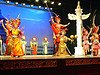
"Beijing night show" dinner theatre holds 500 people at the same time. Delicate Chinese court cuisine will be served with Chinese folk music an hour before "The Grand China Show" begins.The dinner includes appetizer,main course and dessert with changes on special request or according to the season.You can have your choice for standard seats, front seats,VIP seats or box seats.


Peking Opera --- The unique theatrical synthesis of song and dance, acting and acrobatics known as Peking Opera began to emerge in its present form around 200 years ago. Though the Beijing variety is world-famous, there are many different provincial versions of the art throughout China.

Chinese acrobatics
Chinese acrobatics has a long history and is one of the most popular art forms among Chinese people. It has got a world-wide fame for its wonderful skills and marvelous acts.Baol Theatre is the special place for the performances of Beijing Acrobatic Troupe. The performances of this troupe have gained many national and international prizes, and it puts on performances at 7:15 every night. In Chaoyang District, there is another famous theatre, Chaoyang Theatre where you could see acrobatics and other programs of entertainment. It opens at 7:15, too.


Chinese Kungfu
The most exciting Kungfu show in the world. In an ancient temple we encounter a little boy. Through practicing Kungfu and zen he becomes a master and finally reaches the sacred goal of enlightens.

One day Tour in Beijing

1.Tour to the Great Wall and Ming Tombs.

(1-2 pax) RMB 1,100 or US$ 135
(3-5 pax) RMB 600 or US$75/per person

2.Tour to the Forbidden City.Temple of Heaven and summer palace.

(1-2 pax) RMB 1,100 or US$135
(3-5 pax) RMB 600 or US$75/per person

4.The Great Wall of Jinshanling and Simatai.Hiking Tour (Start from the Great Wall at Jinshanling to Simatai.)

(1-2 pax) RMB 1200 or US$ 145
(3-5 pax) RMB 820 or US$100/per person

5.Half day's tour to the Great Wall of MutianYu.

(1-2 pax) RMB 910 or US$ 110
(3-5 pax) RMB 580 OR US$70/per person

(Including tickets, lunch, English guide service and the air-conditioner car/van)

Beijing Tour Guide Service(English)

1 Traveler: USD 50
2-5 Travelers: USD 30 Per person
6-9 Travelers: USD 20 Per Person
Over Travelers: USD 10 Per person
Note:9-hour service from 8:30am to 5:30

One Day within Beijing ( 8 hours)

Private car:USD 80 Per car( from 8:00am to 5:00pm)
van:USD 110 Per Van( from 8:00am to 5:00pm)

Half day within Beijing City 4hs

Half day within Beijing City (4 hours) Rates
private car:USD 60 Per car ( from 8:00am to 12:00am)
van :USD 80 Per Van( from 8:00am to 12:00am)

Beijing Airport--Downtown Hotel Transfer


We provide private cars for your party of 1-2 persons.
$30/car

We provide deluxe van for your party of 3-6 persons.
$50/van

The driver will wait for you at the gate with your name board, he can give you a hand if you have heavy pieces of luggage and offer you a good transfer.
If you need our English speaking guide service, please tell us in advance and pay extra USD 15 per car/van.
Have a nice trip in Beijing!

Monday, September 25, 2006

Olympic FAQs

Q: I really want to go to Beijing to watch the games! Where can I get the tickets?
A: The Beijing Olympic Games schedule is from Aug. 8 to 24, 2008 and tickets will be available from the beginning of 2007. Part of the ticket allocation is to be reserved for competitors' families, with most of them sold in China. However, it is still unclear as to the exact methods of buying these tickets. People can buy tickets via the internet or mobile phones. If you are outside China, you can contact your local Olympic Committee, which are responsible for the ticket selling in your country.
Q: There must be many visitors to Beijing in 2008. Where can we stay during the Olympic Games?
A:There are many good hotels and hostels in Beijing. You can stay in good hotels such as Beijing Hotel, Hilton Hotel, and Beijing New Century Hotel and so on to enjoy a luxury holiday in ancient Beijing city. If you are on a budget, you can choose Youth Hostels, which are also clean and tidy. Since there may be many visitors to Beijing at that time, it is best to book a hotel well in advance. For details about Beijing hotels, you can check Beijing Hotels or the introduction to hotels on the official website for the Beijing Olympics . Another good and comprehensive website of traveling in Beijing is Beijing Trip.

Q: How about communications in Beijing? Can I use my mobile phone Beijing, and what about the internet?
A: In China, GSM network only have two frequencies, 900HZ and 1800HZ so if your mobile phone must be tri-band to use it in China. CDMA is not very popular in China, so it is best to ask the sale agent for details before coming to China. Internet cafes can be found everywhere in Beijing with most of them using broadband connections.

Q: Can Chinese people speak English or are there English-speaking guides/volunteers available during the Olympic Games?
A: Most of the students have learnt English since junior high school. They will be more than willing to help you if you have any problems. What's more, Beijing citizens are learning English. English speaking guides and volunteers are also available to provide better service to our international visitors.

Q: How about the transportation in China? Can I drive in Beijing on an international driver license?
A: The transportation system has been greatly improved in recent years. People can use subway, bus, taxi and light rail to arrive at Olympic Green and other venues during the Olympics. However, you cannot drive in China unless you have a Chinese driving license.

Q: Is there western food available in Beijing as Chinese cuisine is not to my taste?
A: As a modernized capital city, there are many kinds of restaurants in Beijing. Most of the hotels offer both Chinese and Western food. Restaurants offering food of American, Brazilian, French, German, Indian, Japanese, Italian, etc. can be found everywhere in Beijing. You can check details about dining in Beijing.

Q: I like the Olympic Mascots very much! Where can I buy them?
A: There are many souvenirs available for the Beijing Olympics including metal products, clothing and accessories, hats, bags, ties, pens and handicrafts, all with symbol of the Beijing Olympics. You can buy them in many big stores and tourist attractions.

Q: The Beijing Olympics is in August, what will the weather condition be at that time?
A: Though August is not the hottest month of the year, you should pay attention to the strong ultraviolet radiation. The average daily maximum temperature in August is 29C(84F) so it is advisable to bring sunglasses, sun block, and light clothes to remain comfortable in the hot summer weather. Check the detailed information about Beijing weather.

Saturday, September 23, 2006

Beihai Park


Situated in the center of Beijing, Beihai (North Sea) is one of the most popular parks in the city of Beijing. It covers a total area of over 68 hectares, more than half of it is taken up by the lake.

Early in the 10th century, the Liao Dynasty built a secondary imperial residence here, called Yaoyu or Jade Islet. When the Jin took over, they renamed the capital Zhongdu, meaning Central Capital, and built an imperial palace. Qionghua (Jade Flowery) Islet was built of earth dug out from the lake, and the rocks used for piling on the hill were brought from Kaifeng, Henan Province. During the Yuan Dynasty, the place was rebuilt three times, and Guanghandian or the Palace in the Moon where Kublai Khan used to live and many other palace buildings were built on top of the hill. It was in this palace that Kublai Khan received Marco Polo. Unfortunately it was destroyed. The Islet became the centre of Dadu (Great Capital) and is still situated in the heart of modern Beijing.

The Ming Dynasty saw more construction and renovation: the Five Dragon Pavilions and the Nine-Dragon Screen on the north bank of the lake and many pavilions and galleries were erected during that period. From the White Dagoba, visitors can have an excellent view of the Five Dragon Pavilions standing on the opposite bank of the lake, with colourful ferry boats travelling back and forth between the shores. During the reign of Emperor Qianlong, construction lasted for 30 years. The project included many other pavilions, halls and terraces which made the park even more harmonious in design.

The layout of the park is based on an ancient Chinese legend. According to the legend, there were supposed to be three islands to the east of Bohai Bay where the gods lived. One of them was called Penglai Island where a kind of herbal medicine grew, that was supposed to prolong life. The first emperor of the Qin Dynasty wanted to live fovrever. He sent people to the islands to look for the longevity medicine, but failed. Emperor Wudi of the Han Dynasty also wanted to live an eternal life. He ordered that a big pool be dug at the back of his palace, complete with three artificial hills to represent Penglai and the other islands. So these legendary hills were built in the eastern capital of Luoyang during the Sui Dynasty and also in the Tang Dynasty capital of Chang'an. Such a traditional style of gardening was followed during the succeeding dynasties and Beihai Park was built after this traditional style.

Yonghegong Lamasery


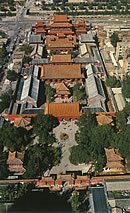
Yonghegong is a famous lamasery located in the northeastern part of the old city of Beijing. It was a palatial residence built in 1694 by Qing Emperor Kangxi for his fourth son, Prince Yongzheng who later succeeded to the throne. This magnificent temple consists of five main buildings lying on the north-south axis, with annex halls standing on both sides. The temple is listed by the Chinese Government as one of the important historical monuments under special preservation.

After the death of his father, Emperor Yongzheng moved to the Forbidden City. The compound was closed to ordinary people and was renamed Yonghegong (the Palace of Harmony). Green roof tiles were replaced by yellow ones to suit a monarch's home. In 1744 his successor Emperor Qianlong converted the palace into a lamasery.

Several renovations have been carried out since 1949. The temple has taken on a new look and was reopened to the public in 1981. It is now not only a functional lama temple, but also a tourist attraction.

Ming Tombs


The Ming Tombs, consisting of 13 emperor tombs of the Ming Dynasty, is situated in the southern foothills of Yianshou Mountain northwest of Beijing. Two of the 13, Changling and Dingling, are excavated and open to the public.

Approach to the Ming Tombs is a seven kilometers stone-paved road, beginning with a very impressive archway of carved white marble erected in 1540, followed by giant-size single-stone statues of 24 animals and 12 humans.

In front of Changling, the largest of the 13 Tombs, is the marble-based 1,956 square meters Ling En Hall built 570 years ago. It is built of very precious wood and is China's largest wooden structure. 4 of the 32 huge pillars stand in the center, measuring 1.17 meters in diameter each. A two-story castle sits in the rear of the main hall.

Dingling is the tomb of Zhu Yijun, the 13th Ming emperor. It consists of similar surface structure and a Underground Palace. The Underground Palace is composed of the front, central, rear, and side halls. The whole palace is built compeletely with stone, and not a single piece of wood is used. There are no beams and the ceiling is arched. The rear hall is the Burial Chamber, where the emperor's coffin and the first and second empress's coffins were placed. Inside the coffins a large number of valuable relics were found. The unearthed relics, including porcelains, jade carvings, silk, woman's head-dresses decorated with golden phoenixes and jewels, wooden seals, and other precious article, are now on display in the Dingling museum.

The Ming tombs were put under protection of the Beijing municipal government in 1957.

In July 2003, the UNESCO World Heritage Committee at its 27th session officially inscribed Ming Tombs (Shisanling) in Beijing on the World Heritage List as assemblage of the Imperial Tombs of the Ming and Qing Dynasties.

Temple of Heaven


Tiantan Park is an icon of such enduring value that it shorthands the entire city. The park's classic Ming architecture gives it heaps of symbolic value and the name has been used to brand products from tiger balm to plumbing fixtures, as well as decorating a plethora of tourist literature. It's set in a 267-hectare (660-acre) park, with four gates at the cardinal points, and walls to the north and east. It originally functioned as a vast stage for solemn rites and rituals.

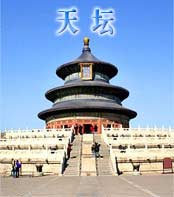
So beautifuly proportioned and positioned that it has become Beijing's "official civic symbol", Temple of Heaven was built between 1406 and 1420, the same time that Ming Emperor Yongle laid out and built the Forbidden City. He oversaw the construction of an enormous park and altar to heaven directly south of the palace. Each year on the winter solstice the emperor would lead a procession out of the Forbidden City across what is today Tiananmen Square southward down the Imperial Way to Tiantan, the Temple of Heaven, where he would perform rites and make sacrifices to the cosmos on behalf of China. Much of the architecture of these ancient rites survives in Tiantan Park (Tiantan Gongyuan), but what makes this park so singular among attractions in China is a single remarkable building, a magnificent tower known as the Hall of Prayer for Good Harvests (Qinian Dian).

The centerpiece Hall of Prayer for Good Harvests that dominates the complex is the city symbol and is a faithful reconstruction of the original, which burned in 1889. Inside, 28 wooden pillars support the 39-meter tower, whose three conical roofs are covered in blue glazed tiles reflecting the sky. The wooden walls are richly decorated inside and outside.

Elsewhere on the 273-hectare (674 acre) site are such wonderfully-named features as the Bridge of Vermilion Stairs, the Imperial Vault of Heaven and the Echo or Whispering Wall, whose remarkable acoustical design carries even whispered sounds over a distance. Nearby are the three terraces of the Circular Mound, where emperors offered up their prayers.

Come in the morning to enjoy the sunrise, breathe in the fragrance of the ancient cypress trees and perhaps join in the tai chi exercises and other activities of the assembled people.

Tickets attractions : 30.00 yuan season (November 1 to next year March 31), season 35.00 yuan (annually from April 1 to October 31)

Opening hours : 6:00——21:00 ( for major building inside 17:30 summer 16:30 winter)

Telephone : 67028866 (switchboard)

Summer Palace


It was designed eight centuries ago as a hot-season getaway for the royal and twice suffered extensively at the hands of Western troops but it retains its considerable beauty today.

Situated 20km northwest of Beijing, in the cool hills that rise from the plain on which the city humidly sits in the summer, Yiheyuan also witnessed extravagant celebrations that kept the pampered elite from boredom. It was further beautified by the Dwoager Empress Cixi, who almost broke the national treasury creating her personal Xanadu.

Today, with the repair of the damage inflicted in 1860 by the Anglo-Frech troops during the Second Opium War and in 1900 by rioters in the aftermath of the Boxer Rebellion, it retains the residence of the Empress Dwoager, Complete with its Furnishings and her personal effects.

The place is packed to the gunwales in summer with Beijing residents taking full advantage of Kunming Lake which takes up three-quarters of the park. The main building is the lyrically named Hall of Benevolence & Longevity, while along the north shore is the Long Corridor, so named because it's, well, long. There's over 700m (2300ft) of corridor, filled with mythical paintings and scenes. If some of the paintings have a newish patina, that's because many of the murals were painted over during the Cultural Revolution.

Long Corridor (Chang Lang)--This covered wooden promenade runs about half a mile (2,550 feet) along the northern shore of Kunming Lake, from the Eastern Halls to the Marble Boat. Its crossbeams, ceiling roof panels, and pillars are painted with more than 10,000 scenes from Chinese geography, history, literature, and myth, making this a promenade into a picture encyclopedia of China. The paintings are crude but bright, and the Long Corridor is exceptionally charming. Built in 1750 (and rebuilt and restored many times since), the Long Corridor consists of 273 crossbeam sections and four pavilions that lead to cafes, boat docks, or sites on Longevity Hill.

Hall of Benevolent Longevity (Renshou Dian)--Located directly across the courtyard from the East Gate entrance, this hall is where the Empress Dowager Cixi and her nephew (who was appointed emperor, but placed under her protection) received members of the court. Cixi occupied the dragon throne.

Hall of Jade Ripples (Yulan Tang)--This is the lakeside residence of the Empress Dowager's nephew, Emperor Guangxu, where he was kept from the throne, a prisoner of his aunt.

Hall of Happiness and Longevity (Leshou Tang)--This complex on the northeast tip of the lake was the Empress Dowager's private residence. Most of the furniture, the bed curtains, and the glass lamps (China's first electric lamps) are original. The Long Corridor begins here.

Great Wall


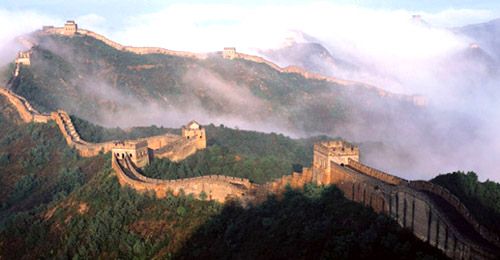
Despite the common assumption, the Great Wall can not be seen from the moon; it can, however, be viewed from astronauts in passing orbiters. It was also not built all at one, ti was built from the 5th to 16th centuries to be completed as a barrier against nomadic invaders from the north. The wall's origins date back at least to the 5th century b.c., when the rival kingdoms of the Warring States Period (453-221 b.c.) built defensive ramparts against their enemies. The First Emperor of unified China, Qin Shi Huang Di, fortified the barriers in the 3rd century b.c. Over a 10-year period, 300,000 conscripted laborers, many of them slaves, knit the walls into a continuous rampart to protect the western frontier. New sections extended the wall east to the Yellow Sea.
The Great Wall was constantly repositioned along new routes as successive dynasties rose and fell. In the year a.d. 607, more than a million workers toiled on this line of defense, but soon after the Great Wall was abandoned. The Mongols eventually broke through from the north and established the Yuan Dynasty (a.d. 1271-1368), making Beijing their capital. Their successors, the emperors of the Ming Dynasty (a.d. 1368-1644), set in motion the last great phase of wall building, which created the Great Wall as we see it today north of Beijing.
Its eastern foot rests in the Gulf of Bohai on the edge of the Yellow (or Eastern) Sea, its western 5,000km (3,333 miles) on the verges of the desert region.

Visitors to Beijing can visit the Wall at three locations: Bakaling, 80km north; and Simatai, 110km northeast. Built during the Ming Dynasty, the Badaling section is 7.8 meters high and 5.8 meters wide. While the ridge can be accessed on foot, the steep ascent is not for everyone and a cable car ride can be substituted.

Another restored sector, at Mutianyu, can also be explored by foot up its long, steep stairs and restful terraces or by a recently installed cable car. Both sides are often crowded, which has been left in its ruined state. However, while visitors to the two restored areas can go by tour bus, those traveling to Simatai must have their own guide and means of transprotation.

Forbidden City

With adjacent Tian'anmen Square, this has been Beijing's centerpiece attraction since more than 200,000 laborers built it for the third Ming Dynasty emperor Yongle in the early 1400s. 24 emperors and empresses of the Ming ans Qing (Manzu) dynasties made this their home and held court here across a span of 5 centures.

The 74-hectare (183 acre) complex is best known as the Forbidden City, denoting the fact that only the royal family, ministers and tribute-bearing ambassador were allowed inside. This ancient royal city, stuck in the heart of the modern city of Beijing like a life-sized time capsule, is nearly a half-mile wide (east to west) and more than a half-mile long (north to south). Its palaces, pavilions, and halls are divided into 9,000 rooms, and the whole complex is enclosed in thick walls over 30 feet tall and by a moat 170 feet across. Now the old world of beautiful concubines and priapic emperors, ball-breaking (and -broken) eunuchs and conspicuous wealth still hovers around the lush gardens, courtyards, pavilions and great halls of the palace.

The first of its three areas has four monumental gates and a moat spanned by five marble bridges. The magnificent Gate of Supreme Harmony, with its bronze guard-lions, leads to flagstone-paved courtyard accommodating 9,000 people on imperial ceremony occasions. The Hall of Supreme Harmony and the bronze incense burners and jade chimes for those events like beyond.

Next are the royal living quarters, whose small, intimate courtyards and palaces are now museums housing the dynastic clock, artwork, calligraphy and other collections. At the back are the ancient cypress and pine trees, and the well in which the Empress Dowager Cixi Drowned a concubine who was threatening her hold on power.

Tiananmen Square


Located in the right center of Beijing, the capital of P.R.China, Tiananmen Square occupies an area of 49 hectares (122 acres), big enough to hold half a million people. As one of the largest city squares in the world, many annual and special celebrations and assemblies are held here. Parades take place here on important days, such as the rallies on May 1, International Labor Day and Oct 1, National Day.

In 1919, the May 4th Movement broke out in Beijing. Students and residents staged a patriotic demonstration in the square. In 1935, students in Beijing launched the December 9th Movement and held a demonstration in the square to against the Japanese aggression and Chiang Kai-shek(Jiang Jie Shi)'s policy of non-resistance. On April 5, 1976, lots of people gathered here to commemorate Zhou Enlai and oppose the 'Gang of Four'.

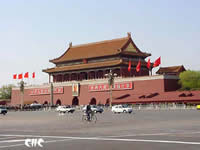
The Tiananmen Gate Tower sites at the north, the Five-Star Red Flag flies high on the square, the Monument to the People's Heroes dominates the center, the Great Hall of the People and the Museum of the Chinese Revolution and the Museum of Chinese History to the east and west of it, as well as The Chairman Mao Memorial Hall and the Zhengyangmen Gate (Qianmen), sit in the south of the square. Tens of thousands of people visit daily. It is the must place to visit in Beijing City.

Admission Fee: Free of charge for square visiting
Opening Hours: Whole day
Recommended Time for a Visit: one hour

Beijing--Chinese capital


Beijing
, the capital of the People's Republic of China, is the nation's political and cultural center. Some 690,000 years ago, Peking Man lived at Zhoukoudian, 48 kilometers southwest of Beijing. A small town appeared on the present site of southwestern Beijing in 1045 B. C. It was named Ji and then changed to Yan. At the beginning of the 10th century, it was the second capital of the Liao Dynasty. From then on, the city had been the capital of the Jin, Yuan, Ming and Qing dynasties until 1911. In the early twenties, Beijing became the cradle of China's new democratic revolution. The May Fourth Movement against imperialism and feudalism began here in 1919. On October 1st, 1949, Chairman Mao proclaimed to the whole world the founding of the People's Republic of China.

Population: approx 14,000,000 fluctuating daily

The total municipal area: over 17,800 square kilometers

Administrative districts of Beijing municipality: total 2 suburban counties(Miyun and Yanqing) and 16 urban districts including Dongcheng, Xicheng, Chongwen, Xuanwu, Chaoyang, Haidian, Shijingshan, Fengtai, Shunyi, Changping, Mentougou, Tongzhou, Fangshan, Daxing, Huairou and Pinggu.

Beijing city trees: the scholar tree and oriental cypress

Beijing city flowers: the Chinese rose and the chrysanthemum