Beijing Trip Guide

Wednesday, November 29, 2006


Wednesday, November 22, 2006
Tuesday, November 21, 2006
Monday, November 20, 2006
silk road
Silk Road
China's vast western region is accessible to travelers along the classic Silk Road, the most important connection between the East and West. Goods traded along the route were mainly silk products and the name Silk Road.
At that time, only China grew mulberry, raised silkworms to make silk products. In 133BC, Emperor Wudi of the Han Dynasty (206BC-220AD) ordered to invade the Huns and established a relation with the west. In 77BC, Han invaded the Loulan state and in 60BC, the superintended government was set up to promote economic and cultural exchanges between them.
This ancient trade route starts in the old capitals of Luoyang and Xi'an (then called Chang'an), reaches the Yellow River at Lanzhou, then skirts westward along deserts and mountains before dividing into three routes at the oasis of Dunhuang.
When the ancient Silk Road came out of the Hexi Corridor into Xinjiang, it broke into three main sections. The eastern section ran from Chang'an to Yumen Pass or Yangguan Pass. The central section started from Yumen Pass or Yangguan Pass to Chongling (the Pamirs). The western section was divided to two routes: one ran through Iran, Iraq and The Mediterranean Sea to reach Europe, and the other ran northwestwards to reach Europe via the Aral Sea, the Caspian Sea and the Black Sea.
Generally speaking, the Silk Road brought the constant exchanges between the East and the West. Chinese textile products, papermaking technique and some art crafts were introduced to the west through the route. And the western music, dancing, painting astronomy, calendar and Buddhism were introduced into China.
There was also a Marine Silk Road which connected the southern China and the West.
people-chen 11/21/06, 1:32am
Beijing to build world's longest metro
According to the plan, the 561 kilometres will be laid out along 19 lines knit together beneath the capital.
Unlike metro lines 1 and 2 (the loop lines), which encircle the Tian'anmen Square area, the traditional city centre, the new lines are expected to reach all the major corners of the capital.
Fifteen of the new lines will support urban areas, while the remaining four will stretch out to the suburbs, according to the plan drafted by the city's communications commission.
Zhao Hui, a researcher who helped draft the plan, said it represented a long-term vision and was therefore subject to change. The city's Development and Reform Commission still has to approve the plan, he noted.
The three lines Line 4, 5 and 10 that are currently under construction are expected to be operational for the 2008 Olympic Games.
Line 4 will connect Fengtai in the extreme south with Haidian in the northwest, spanning 28.16 kilometres. This line will represent the first direct link between Beijing's two "poles."
Line 5 will serve a similar function, creating a short-cut route between the "developed" north and "developing" south, from Changping to Fengtai districts.
The city is also building Line 10, which will proscribe an arc whose tips will be Haidian and Chaoyang districts. This line will link up the northwestern and eastern-southeastern sections of the city.
A 5.91-kilometre section of Line 10 is aimed at easing travel relating to the 2008 Olympic Games.
Zhao said Line 11 would be finished in 2012 and link with Line 10. The new loop line created by the two linked lines will thread through major city centres including Zhongguancun technology zone, the CBD and the Olympic zone.
Currently four metro lines serve Beijing. Lines 1 and 2 span 54 kilometres, while Line 13 and Line Batong cover 61 kilometres. Together they carry 1.5 million travellers every day.
Beyond building new subway lines, transportation experts have been exploring other possibilities for the city's underground space to help ease the traffic pressure.
During a conference this weekend entitled the "International Academic Conference on Underground Space," the Beijing Urban Planning Commission and Beijing Urban Planning and Designing Research Institute jointly released a new plan proposing the construction of six underground expressways by 2020 to further ease traffic congestion, mainly within the second and third rings.
Shi Xiaodong, a senior planner with the planning and design research centre, said moving more transportation underground will help eliminate noise pollution and reduce traffic in the old urban area.
However, Duan Liren, an expert with the Beijing Transportation Management Engineering Institute, warned the involved officials to be cautious about developing the underground express system.
"Such a large-scale underground expressway system would be unprecedented in the world, and we have little experience to draw upon. The technological difficulties and construction costs of this system will exceed those of the metro system," Duan was quoted by the Beijing News as saying.
China UnionPay Selects AT&T to Support Its Rapid Global Expansion Plans
China UnionPay chose AT&T as its networking services provider during this challenging expansion phase due to AT&T's unrivalled global network and experience in supporting global companies with complex networking requirements. The cooperation between CUP and AT&T will provide CUP cardholders with safe and secure payment services when they are abroad.
About China UnionPay
China UnionPay Co., Ltd, approved by the State Council and licensed by the People's Bank of China, is a shareholding financial service institution established through capital contributions by more than 80 domestic financial institutions. The Shanghai-based China UnionPay ("CUP") was officially incorporated on March 26, 2002. To date, CUP has altogether 18 branches and 166 members, among which 23 are overseas financial institutions. Major subsidiaries under CUP include CUP Merchant Services, CUP Data, ChinaPay e- Payment, China Financial Certification Authority, etc.
CUP is committed both at home and abroad to improving the bankcard acceptance environment. It has achieved the goal of nationwide bankcards interoperability and launched successively the CUP card acceptance in Hong Kong, Macao in 2004, and Singapore, Korea and Thailand in early 2005. CUP will continue to develop the overseas acceptance network to realize the vision of "touring the world with a CUP card" and build the CUP brand into an international payment brand. Additional information may be found at: http://www.chinaunionpay.com/englishversion
Tuesday, November 14, 2006
Sanlitun Bar Street and the sensual extravagance, the Transitional ShiChaHai lose momentum in the last.
But up to the bar or more scattered sea after a fire spread to the sea before, the more and more people to go. Some say that the Transitional ShiChaHai truly touching "details. Marketplace happy with the fragrance of the wine end, the ancient courtyards and fashion trends bar.
indeed, a "Beijing characteristics.
Transitional ShiChaHai off to the bar is about the quiet. Here is a drink to leave feeling for the truth, a lot of bars and decorating quite important, too. "knew the maid belonged to the nobleman" unusual compound is the spears of anger; "Buddha bar" is not the place to do a religious ambience. Before the sea "small Palace," more personality, "we have given the impression that people who take money came open. you money, do not meet our requirements, we do not wait. "
Transitional ShiChaHai bar most moving, standing still can view : "Yindingqiao", the hearing board erhu long, Reapproaching Saying Good taste is the most; more water wax lights, Iraqis staged, These may be the only memories mankind has left.
Star King th sitting right way : by Lufthansa, Levin popular too commercial, adjacent to the embassy district of the third. This bar provides a way for customers sing bars. And the north quiet, inside the Mirror Lake, the water wave trough Yan more to say about this new bar Tim discovered gas. BORDERING small sit breeze study, the table candlelight flickered, as a mirror before Minghu, more lights shining from afar, Yanshu creepy. Yuen added to the city dream.
"Plane Star" Star bar is a very normal way of things : Chun come "enjoy rich foods and fine attire." Over there is not far from the "write legend," and "new high shipped bars" regular rock performance, how that "Star right path" since the names have not unprovoked.
Street east of the bar "over the edge Bi" is the only one African Well, if attention will be heard in the concert band is a wilder blacks "Casablanca".
Sunday, November 05, 2006
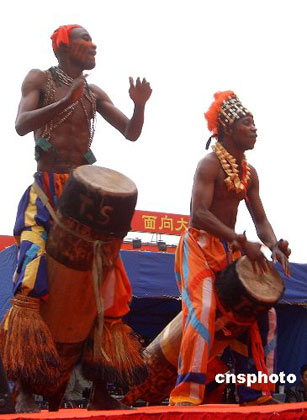
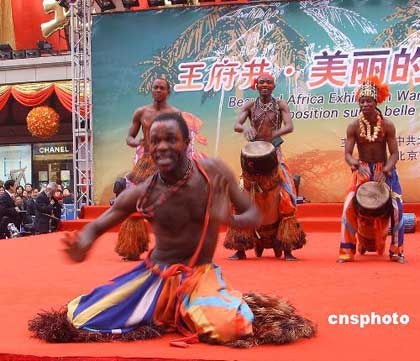
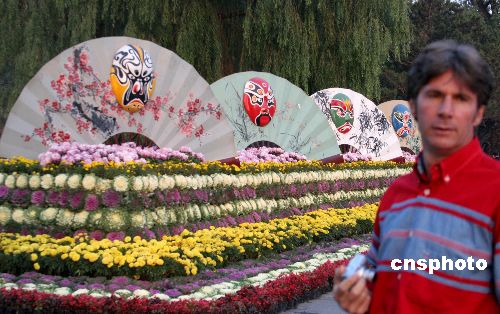
Beijing make African friends like at home
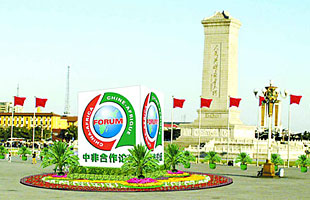
At the airport, along the highway, in the bustling Xidan commercial district, Wangfujing walking the streets in the surging crowd. A huge picture of the African landscape painting, as late autumn, the city bright spot. This is the ancient capital of the Orient, with great enthusiasm, to meet the upcoming summit meeting of the Sino-African Cooperation Forum in Beijing.
To create the feeling of home to the African guests, Beijing's streets could see the African landscape drawing board. Xicheng District where the main venue of the summit here. In different sections of the total exhibition area of over 4,000 square meters of African Cinema. In Tiananmen Square, chewing bamboo and palm trees and other tropical plants were eye-catching composition of the green landscape.
Every major holiday activities Tiananmen Square can see a wide range of plants or landscape, this most special. "Wang lives in the old saying, while my granddaughter for taking pictures.
"To enable all African guests the feeling of being back home. "In a meeting at the hotel reception staff understood that the preparatory work for the hotel.It is learned that leaders of African countries will be participating at the hotel to enjoy the many personalized service. Nearby hotel housekeeper use English, French and the mother tongue of the host country, and that is readily available services. Night in bed services, like hotel guests prepared by the pillow, or even leaders, and his wife prepared for the image. slippers and off stationery printed with his name and so on.
In catering services, hotels and African embassy in China ties According to the delegation leaders and food preferences and adjustments. even VIPs like the color knows with perfect. Hotel occupancy also understand some of the delegation's birthday, will coincide with the birthday guests sending blessings.
Information Center is the busiest areas of this summit. Chinese and foreign reporters to provide highly efficient and convenient services at the same time, the staff also takes into account the loving care. Information Center prepared a rich layer of information about China. Information center ticket Post photo-processing services, but also devoted a temporary clinic set up by two doctors. During the meeting, there is a free buffet and refreshments.
Beijing residents have shown great enthusiasm. As a country with a population of 14 million mega-cities. inevitably, every major international meetings to worry about traffic and security, but a city manager could breathe a sigh of relief. A week before the start of "less driving and driving" initiative received broad support. According to the Beijing Municipal Environmental Protection Bureau statistics, participation Cheyoukuai has reached 380. adding to the public's already exceeded 25 million.
In Beijing, the park courtyard and some institutions. Africa through various forms of dissemination of knowledge and etiquette is also a time that Africa has become the focus of discussion topics. Beijing's embassy district PILIPILI Africa begin the third operator Lu Chun-ming said that during the summit meeting. He will launch the bars "Africa hot" African features cultural performances and the introduction of African products.
"There is an old Chinese saying goes, 'a friend from afar!'. We look forward to the arrival of African friends. I hope every one of them with their people, friendly, optimistic, civilization, display the excellent spirit of the Chinese people. "Beijing residents say.
Summit declaration China Africa
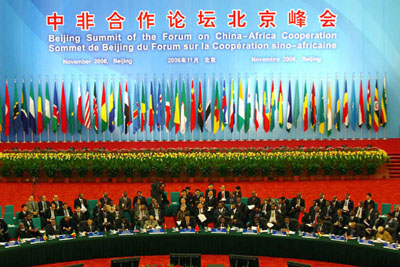
The Beijing Summit of the Forum on China-Africa Cooperation adopted a declaration in Beijing on Sunday, proclaiming the establishment of a new type of strategic partnership between China and Africa.
The strategic partnership features "political equality and mutual trust, economic win-win cooperation and cultural exchanges, " said the declaration, which was adopted by leaders of China and 48 African countries attending the summit.
The declaration called for enhancing South-South cooperation and North-South dialogue to promote balanced, coordinated and sustainable development of the global economy to enable all countries to share its benefits and realize common development and prosperity.
The declaration called for enhancing South-South cooperation and North-South dialogue to promote balanced, coordinated and sustainable development of the global economy to enable all countries to share its benefits and realize common development and prosperity.
Wednesday, November 01, 2006
Beijing Summit opportune for Sino-African cooperation
During the opportune meeting, Chinese and African leaders are expected to review the past 50-year friendly cooperation, and the achievements made since the setting up of the Sino-African cooperation forum. The two sides will also decide to forge a new strategic partnership with political equality and mutual trust, economic cooperation and collective benefit, and cultural exchanges.
It is firmly believed that the meeting would open up new paths, add new content and infuse new vigor in the cooperation between China and Africa.
Nowadays, safeguarding world peace, promoting development, and reinforcing cooperation have become the common aspirations of the people of all countries.
With continued development of political multi-polarization and economic globalization, the momentum to resolve all disputes, and promote joint development through global and regional cooperation, and cooperation within a region, have all been in an upward trend.
The Beijing Summit will surely promote China-Africa cooperation, provide new impetus for regional cooperation, and boost world peace and development.
The meeting, to be held on the occasion of the 50th anniversary of the establishment of Sino-African ties, is of special significance as Chinese and African leaders gather in Beijing to review the past and preview the future.
Over the past half a century, Sino-African friendly cooperation has undergone numerous historical events worth commemorating and cherishing. As Chinese President Hu Jintao said during his visit to Nigeria in April, history has witnessed the milestones of Sino-African friendship.
At present, China and African countries have maintained close political ties. High-level mutual visits, and personnel exchanges between the two sides have become more frequent. Their economic and trade ties has developed rapidly, and consultation and coordination in international affairs has enhanced gradually.